The menu of horror

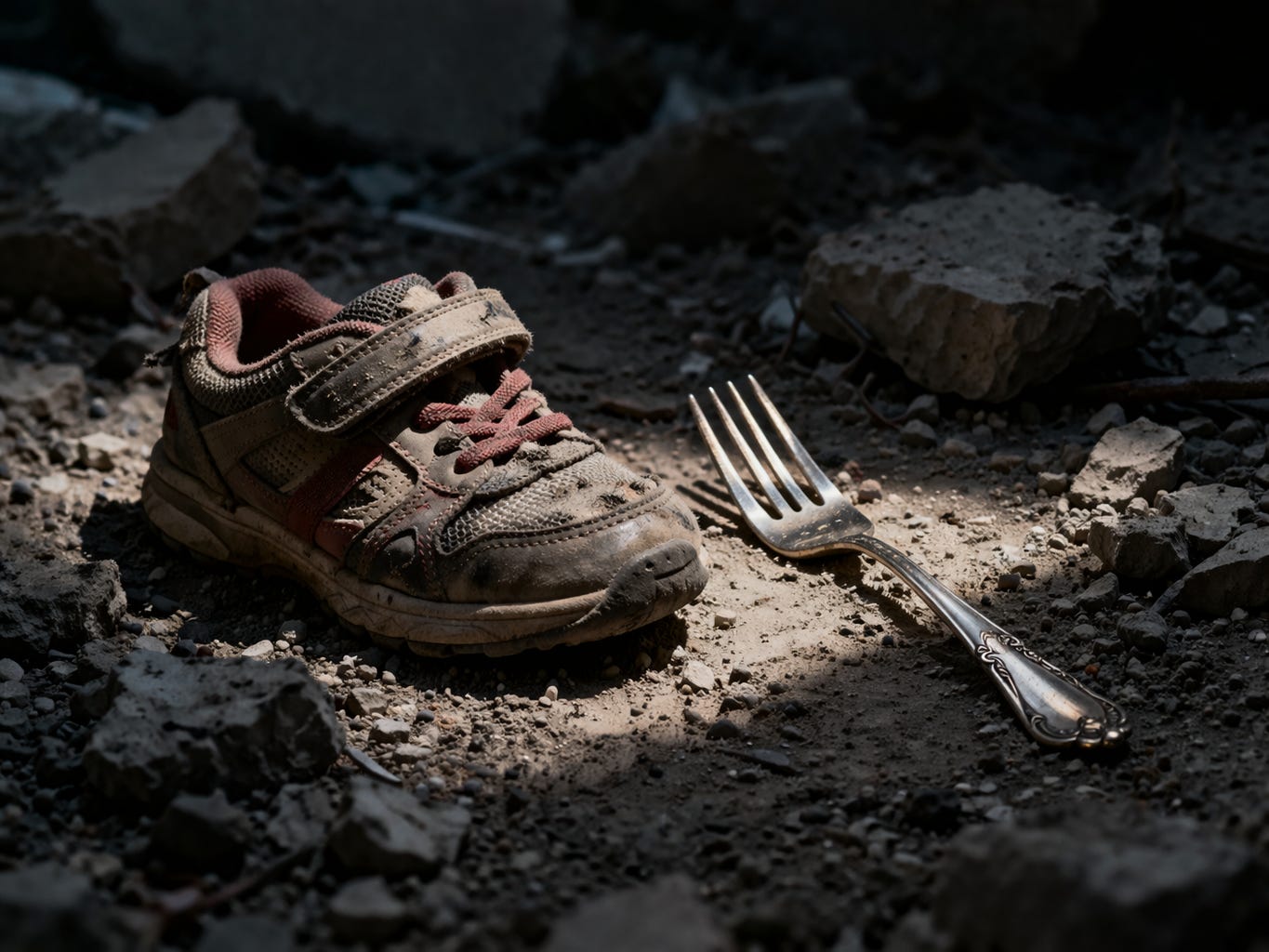
The Menu of Horror
War, for some is a tragedy,
for some others it is a delicacy.
This is not a short list.
This could be a long list.
Long as the day,
as the years,
as the centuries.
But nowadays restaurants stay classy,
the crime is old,
the forks are new.
Two children thrown alive into a common pit,
pushed by a bulldozer.
Hearing the screams of children suffocating under the dirt.
Screaming like mice in a trap.
These cooks can bear it.
Burned alive inside a school,
at a table in front of a window,
by an incendiary bomb.
These cooks can bear it.
Hunted by snipers like little cats.
Children, not cats.
Monday the skull,
Tuesday the kneecap,
Wednesday the neck,
Thursday the chest,
Friday is off until Sunday,
and on Sunday they eat double,
double like
1 bullet:
2 kill.
These cooks are big game hunters.
He blew up a villa as a romantic gift to his fiancée.
These cooks have fine taste.
The underwear of a teenager whose dead body is still warm,
brains scattered on the walls,
underwear like a small balaclava
pulled mockingly over his head.
These cooks have style.
They are little murderous Shakespeares
of the theater of savagery.
Tonight’s premiere:
“How to Sodomize a Prisoner with an Iron Bar.”
These cooks have culture.
Tonight the crocodiles are watching the play in awe.
These actors know better
how to shed crocodile tears
than the crocodiles themselves.
These cooks know how to cry.
These cooks know how to lie.
These cooks are eating humans.
Many, many restaurants,
These cooks know how to feed their rabid dogs,
Lips licking, salivating, waiting for the feast on the menu,
starved for a fresh killed,
Or kill?
yum yum,
blood for the bloodthirsty
on a Sunday afternoon.
Today’s special:
child trapped under the rubble,
slowly bleeding his life out and agonizing
in the silence and indifference
of the world,
No Amber Alert for that one.
Maybe a bullet in the head,
like for old horses,
if a cook passes by,
loves children,
wants to help.
These cooks have one last dish for dessert:
a rotten carrot.
Bon appétit!
Author’s note
This poem is a witness to documented atrocities against civilians and children. It names no religion, no ethnicity, no people. It indicts specific acts and the systems of power and indifference that permit them.
Criticism of the actions of a state or its military is not hatred of a people. Documenting war crimes is not bigotry. Bearing witness is not incitement.
The images in this poem are drawn from verified reports by the United Nations, Amnesty International, Human Rights Watch, and independent journalists. They have happened. They are happening. They are on the record.
This poem belongs to the tradition of witness literature that includes Neruda writing about fascist Spain, Forché writing about El Salvador, and every poet who has ever refused to look away. None of them were writing about races. All of them were writing about power.
If your response to a documented atrocity is to accuse the witness of hatred, the question worth asking is why.