The Hydraulic Pyramid Theory
How Ancient Engineers May Have Used Water to Build the Great Pyramids

Speculative archaeology Alternative theories
They built the pyramids with water
A coherent theory requiring no lost technology, no extraterrestrial help. Just physics and common sense.
April 15, 2026 12 min read Original theory
10,000 BCE — a natural lake at Giza
The Great Pyramids of Giza remain one of humanity’s deepest mysteries. Not because they are inexplicable, but because we may have been asking the wrong questions from the start.
What if the problem was never how to lift 2.5 tons of limestone 100 meters into the air, but when the pyramids were built, and in what landscape?
“The Sahara was green. Giza sat beside a lake. And a block that floats weighs almost nothing.”
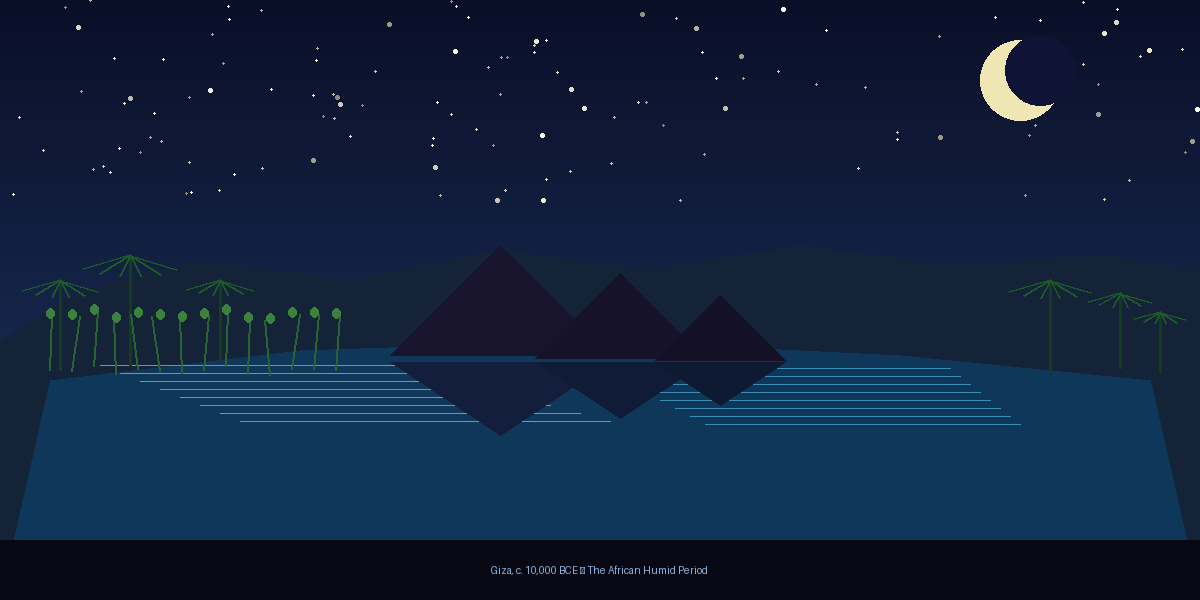
The green Sahara
Between 11,000 and 5,000 BCE, North Africa experienced what geologists call the African Humid Period. Monsoon patterns extended further north, feeding permanent lakes, rivers, and wetlands across what is now barren desert. Hippos and crocodiles lived deep in the Saharan interior. The evidence is everywhere, buried under millennia of sand.
In this context, Giza was not an arid desert plateau. It was a lakeside plain. Geologist Robert Schoch has argued that the erosion patterns on the Sphinx are consistent with prolonged rainfall erosion, not the wind and sand erosion expected if the structure dated to 2500 BCE. That kind of deep vertical weathering points to a much older, wetter world.
Buoyancy as a weight neutralizer

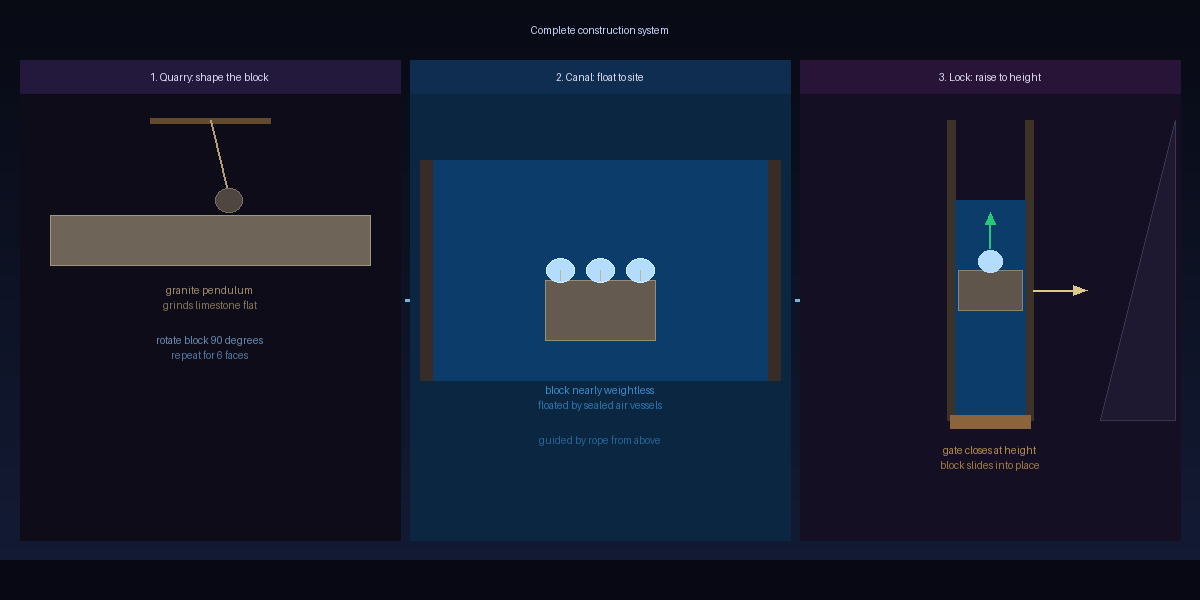
A 2.5-ton limestone block in air is a colossal problem. The same block in water, attached to hollow floats (sealed animal bladders, clay jars, wooden chambers) becomes nearly weightless. Archimedes’ principle offsets the bulk of the mass. At near-neutral buoyancy, a block that would require hundreds of workers to drag across land can be guided by a small crew using ropes, like a marionette suspended just below the surface.
limestone block2.5 tons in airrequires 800 workersblock + floatsnear-neutral buoyancyguided by a few workers
The same block, two radically different situations
The water lock
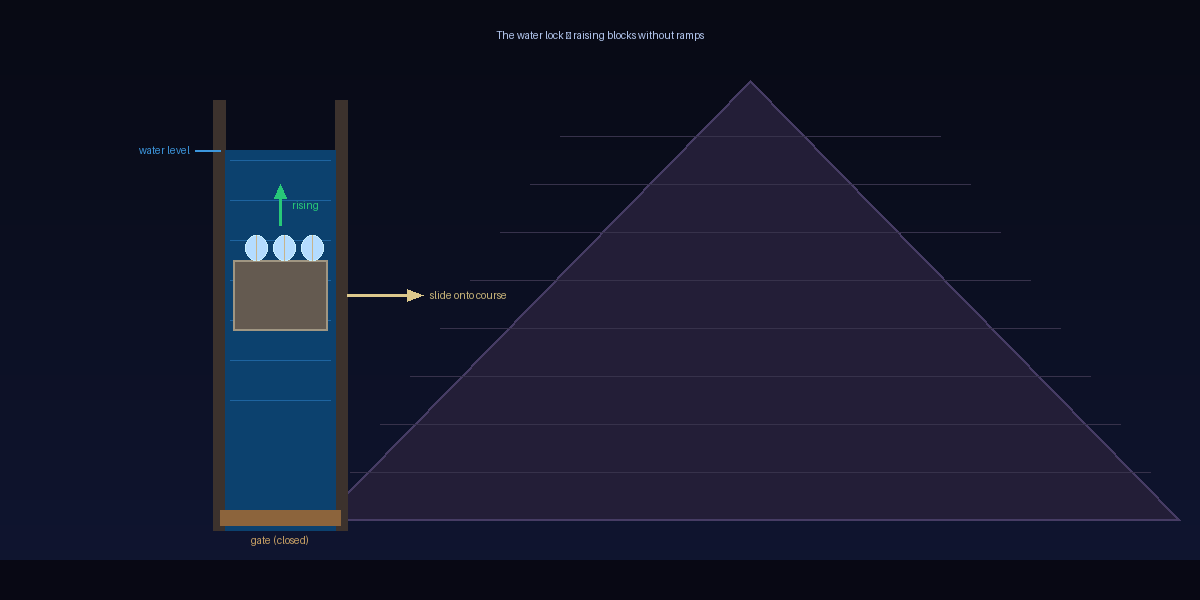
Floating blocks to the site solves horizontal transport. The vertical problem; raising blocks to height, is solved by the same principle that makes canal locks work. A vertical channel is filled with water. The buoyant block rises with the water level. When it reaches the right height, a gate at the base is closed, trapping the water column. The block is then guided sideways onto the course being laid, while the water slowly drains and the block settles into place.
No ramp. No crane. No extraordinary labor. Just a timber gate, an earthwork channel, and gravity doing what gravity does.
How much water?
Lock system by phase: three tiers of construction with actual cubic meter calculations per cycle, scaled by lift height (17m base, 62m middle, 115m upper courses), showing how daily water demand evolves across the build.
Water recovery: the key insight that lock water drains and can be recirculated. At 70% recovery, net consumption drops to roughly 13,500 cubic meters per day at peak, which triggers the pull quote comparing it to the Nile’s two-second output.
Full 100-year total: 54 million cubic meters net, against the Nile’s 84 billion annual flow. Less than 0.065% of one year of Nile discharge for the entire project.
Canal network: standing water volume, seepage losses, passive replenishment.
Grinding stations: wet grinding water use calculated at 26 cubic meters per day across all 65 stations. Negligible.
Final synthesis: 15,000 to 20,000 cubic meters per day peak, no pumping required, just sluice gates and gravity. Exactly the kind of water control these civilizations were already doing for agriculture.
The dam model: never lifting anything at all
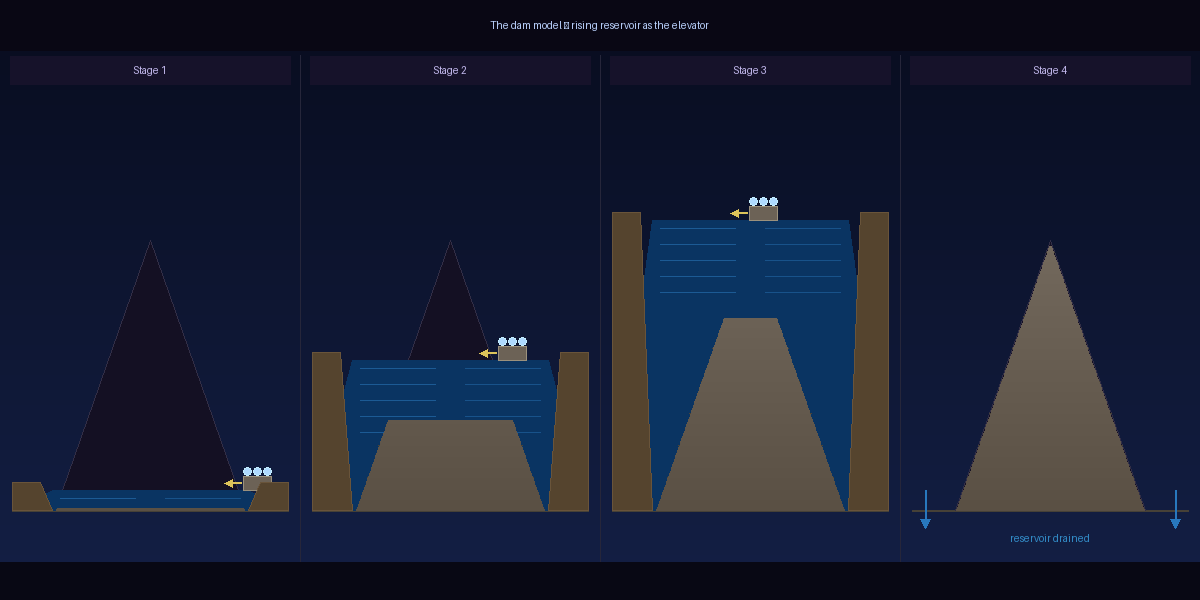
The dam model resolves what every other theory struggles with: how do you raise 2.3 million stone blocks, some weighing several tons, to heights approaching 150 meters, without cranes, without steel, without any mechanism we would recognize as advanced technology?
You do not raise them at all. You let the water do it.
The principle is disarmingly simple. You build an earthwork dam enclosing the construction site — a compacted clay and rubble berm, roughly 330 meters on each side, the kind of water management structure ancient Egyptian civilization had been building for agriculture for generations. You fill the enclosed basin from the adjacent lake or a canal fed by the Nile. And then you begin building, not from the top down, but from the bottom up, at the water’s edge.
The first courses are laid at ground level, in shallow water or on dry ground. When a course is complete, the water level is raised slightly, and the next batch of blocks is floated in from the quarry canal at the new waterline. Workers standing at the water’s edge guide each block into position with ropes. The block, attached to its hollow floats, weighs almost nothing in the water. There is no lifting. There is no ramp. There is only the current course, the floating block, and a few men with ropes doing what fishermen do. Then the water rises again, and the process repeats.
Every block in the entire structure was placed at the waterline. The pyramid did not grow by hoisting stones into the air. It grew the way a coral reef grows — upward through a column of water, one layer at a time.
The water itself presents no serious supply problem. The reservoir at peak construction holds roughly 11.5 billion cubic meters, but almost none of it is consumed. When construction is complete, the sluice gates open and the water drains back into the Nile system over a period of weeks. The only permanent loss is evaporation over the century of construction — roughly 16 to 22 million cubic meters in total, the equivalent of about 55 hours of Nile discharge. The daily operational supply needed to compensate for evaporation and canal seepage is approximately 900 cubic meters per day. A single modest irrigation canal, well within the engineering capability of any early agricultural civilization, supplies that passively and continuously.
The real engineering challenge in this model is not the water. It is the dam. A structure that must ultimately stand 146 meters tall, hold back billions of cubic meters, and grow steadily upward in pace with the pyramid inside it is not a trivial undertaking. It would have required stone-faced inner walls to manage seepage, careful drainage systems at the base, and constant maintenance over a century. It was, in its own way, as remarkable as the pyramid itself.
And it left no trace whatsoever. Earthwork dams erode. Their materials get reused. Their foundations get buried under alluvial deposits. Ten thousand years of desert conditions and Nile flooding would reduce even a colossal clay and rubble structure to an unrecognizable undulation in the landscape. We would not know what we were looking at even if we were standing on top of it.
The pyramid survived because it was designed to last forever. The machine that built it was designed to disappear. One was stone. The other was water and earth. And water and earth, in the end, always return to where they came from.
The pendulum grinder

Lifting the blocks is one problem. Shaping them precisely is another. The proposed solution is equally low-tech: a harder stone (granite, quartzite) suspended on a rope or wooden arm, swinging as a pendulum over a softer limestone block positioned beneath. The consistent arc of each swing grinds the surface flat. Rotate the block 90 degrees, repeat. Six faces, six passes, one perfectly squared block.
Ancient Egyptians used dolerite balls to abrade granite at the Aswan quarries. Hundreds of these balls have been found on site. The conventional reading is that workers held them by hand. This theory proposes they were the head of a suspended pendulum. The archaeological record would look identical either way.
“If you want to shape stone, let a harder stone do the work. If you want to move something heavy, put it in water first.”
Shaping blocks at the quarry: pendulum grinders
One pendulum machine probably needs 2 people to keep it swinging and rotate the block between faces. If you can dress one block per day per machine, and the pyramid needs roughly 2.3 million blocks over say 100 years of construction, you need about 63 blocks per day. So maybe 130 people running 65 pendulum stations simultaneously. Call it 150 including supervisors and maintenance.
Canal transport
A neutrally buoyant block needs maybe 3 to 4 people to guide it along a canal. If 63 blocks are moving per day and each takes half a day to float to site, you have maybe 30 blocks in transit at any time. So roughly 120 to 150 people on water transport.
The water lock operation (if it is the retained system vs. dam system)
Each lock cycle needs maybe 5 to 6 people, someone managing the gate, someone controlling water flow, 3 to 4 guiding the block onto the course. If you run say 10 lock shafts simultaneously to keep pace, that is 60 people on lifting.
Block placement and finishing
Once the block is at height, it still needs to be guided precisely into position. Maybe 6 to 8 people per block. With 10 shafts running, 80 people on placement.
Water supply and infrastructure
Keeping the lock channels filled, managing sluices, maintaining canals. Probably 200 people in a water management role, this is actually the biggest workforce in the system.
Total
Roughly 600 to 800 people in active construction roles at any given time. With support, food, tools, rope making, float construction and maintenance, administration, maybe 1,500 to 2,000 people total.
What that means
The conventional estimate runs from 20,000 to 100,000 workers. The hydraulic system, if it worked as described, would reduce that by a factor of 10 to 50. Not a slave army. A skilled, organized workforce roughly the size of a small town.
Which actually fits the archaeological evidence better, the workers village found near Giza housed somewhere between 1,500 and 2,000 people. Mainstream archaeologists treat that as the support crew for a much larger workforce. The theory suggests it was essentially the entire operation.
That village may be the most underrated piece of evidence for the theory.
Why the evidence is gone
Earthwork channels eroded. Timber gates rotted. Animal bladder floats dissolved. The wooden frames of pendulum grinders left nothing behind. What survives is the only component built to last: the stone itself.
The desiccation of the Sahara after roughly 3500 BCE erased the hydrological landscape that made this system conceivable. By the time the dynastic Egyptians inherited these structures, they were standing in a desert with no water in sight and no living memory of how any of it was done.